
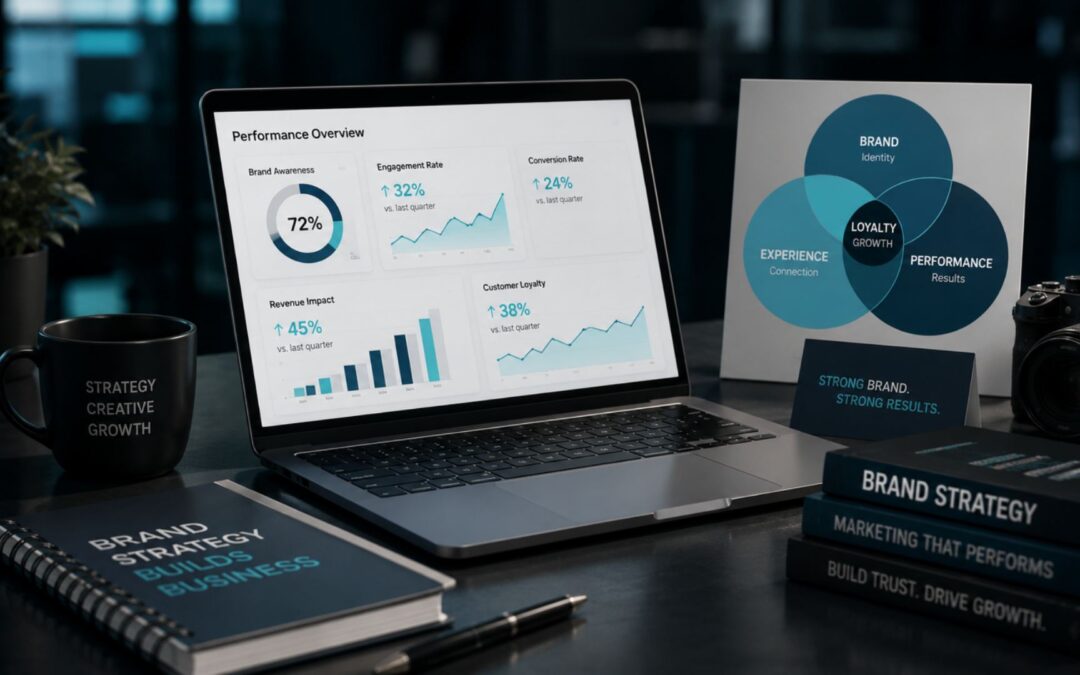
For years, marketing was split into two camps: “brand” on one side (logos, awareness, the fuzzy long game) and “performance” on the other (ads, clicks, conversions, the stuff you can measure). Brand was treated as a cost. Performance was treated as the engine. That divide is now outdated — and clinging to it is quietly costing businesses money.
The short answer: Branding is now a performance strategy because a strong, familiar brand directly improves the numbers performance marketers care about. Familiar brands earn more clicks, convert at a lower cost, get cheaper ad results, rank more easily, and are more likely to be recommended by AI tools. In other words, brand-building isn’t separate from performance — it’s one of the most powerful ways to make your performance marketing work harder.
Here’s how that plays out, point by point.
Brand Familiarity Increases Click-Through Rates
Think about your own behaviour. When you search for something and see ten results, which do you click? Usually the name you recognize. Familiarity is a mental shortcut for “this is safe and credible,” and it happens in a split second.
This is why brand familiarity lifts click-through rate (CTR) — the percentage of people who actually click your listing or ad versus just scrolling past. Two businesses can show up in the exact same spot, with similar copy, and the recognized brand will pull more clicks simply because people trust the familiar option.
That matters far beyond vanity. In search ads especially, a higher click-through rate tends to improve your ad quality scores, which can lower what you pay per click. So familiarity doesn’t just win more clicks — it can make each of those clicks cheaper. [VERIFY: if you want to cite a specific CTR uplift figure, pull a current, sourced statistic rather than estimating.]
The takeaway: every dollar you’ve invested in being recognizable pays itself back inside your performance campaigns, before a customer has even reached your site.
Brand Search Volume as a Growth Indicator
Here’s a metric most businesses ignore: how many people search for your name directly. Not “digital marketing agency” — your actual brand.
Brand search volume is one of the clearest signs of real growth, because it captures demand you’ve created. When someone types your name into Google, they’re not discovering you — they already know you and are coming back. That’s the difference between renting attention (paid ads) and owning it (a brand people seek out).
Rising brand searches usually signal that your awareness efforts are working: more people know who you are, and a growing share of your traffic is essentially free, high-intent, and ready to buy. Falling or flat brand search, even while you pour money into ads, is a warning sign that you’re buying clicks without building anything that lasts.
It’s also one of the most honest indicators of brand health, because it’s hard to fake. People don’t search for businesses they’ve never heard of. [VERIFY: how you describe tracking this — tools like Google Search Console and keyword tools show branded search trends; confirm what SocialEyes uses with clients.]
How Trust Lowers Cost Per Acquisition
Cost per acquisition (CPA) is what it costs you, on average, to turn a stranger into a paying customer. It’s the number that decides whether your marketing is profitable. And trust is one of the biggest levers on it.
The logic is simple. A customer who already trusts your brand needs less convincing. They hesitate less, abandon fewer carts and forms, and move through your funnel faster. A customer who’s never heard of you needs to be reassured at every step — and each point of friction is a chance to lose them, which drives your acquisition cost up.
So when you build trust before the sales conversation — through reputation, consistent presence, and recognizable branding — you’re effectively pre-selling. The performance campaign that finally converts the customer looks cheap and efficient, but a lot of that efficiency was earned earlier by the brand. [VERIFY: avoid quoting a specific CPA reduction percentage unless you have a sourced figure.]
This is the heart of why branding is a performance strategy: it doesn’t replace performance marketing, it makes the math behind it dramatically better.
The Overlap Between SEO Authority and Brand Perception
People often treat SEO (ranking in search) and branding (how you’re perceived) as completely separate disciplines. They’re increasingly the same thing.
Search engines are trying to do what a smart human would: surface the most credible, trustworthy source. The signals they use to judge that — consistent mentions across the web, quality links, strong reviews, people searching for you by name, time spent on your content — are largely the same signals that build brand perception in the real world. A business the public sees as a leader tends to look like a leader to search engines, too.
This overlap creates a compounding effect. Brand-building activities (PR, content, being talked about) strengthen your SEO authority. Strong SEO puts you in front of more people, which builds more brand familiarity. Each side feeds the other. [VERIFY: frame search “authority” as general best practice — describe the direction rather than asserting exact ranking mechanics, which Google doesn’t fully disclose.]
The practical implication: you can’t fully separate “doing SEO” from “building a brand” anymore. Done right, they’re one investment with two payoffs.
Why Invisible Brands Pay More for Ads
Here’s the part that should get every budget-conscious decision-maker’s attention. If your brand is invisible — unknown, unsearched, untrusted — you don’t just miss out on free attention. You actively pay more for the paid attention you buy.
It works through a few connected mechanisms. Unknown brands tend to earn lower click-through and engagement rates, which can hurt ad quality scores and push up cost-per-click. They convert worse once people land, which raises cost per acquisition. And because they have no existing demand to capture, every single customer has to be bought cold, at full price.
A strong brand, by contrast, gets a discount at almost every step: cheaper clicks, easier conversions, and a base of warm demand that’s far less expensive to reach. [VERIFY: the specific relationship between brand strength and ad costs varies by platform and industry — describe as a general pattern, not a guaranteed rate.]
So the choice isn’t really “spend on brand” or “spend on ads.” Skipping brand-building just means your ad spend buys less. The invisible brand pays a hidden tax on everything it does.
How AI Recognition Patterns Favor Strong Brands
The way people find businesses is shifting fast. More and more searches return AI-generated answers — the summaries at the top of Google, and responses from tools like ChatGPT — instead of a simple list of links. And these tools have a noticeable bias: they favour brands they recognize.
AI answer tools are trained on, and pull from, vast amounts of public information. A brand that’s widely mentioned, reviewed, written about, and searched for shows up consistently in that data — so it’s far more likely to be named, recommended, or cited in an AI answer. A brand that’s barely present online simply isn’t part of the conversation these tools can draw on. [VERIFY: specifics of how any given AI tool selects or recommends brands change frequently and vary by platform; describe the pattern, not exact mechanics.]
The reassuring part is that there’s no separate trick here. The same things that make you a strong, recognizable brand to humans — consistent presence, real reputation, being talked about — are what make you visible to AI. Building your brand is your AI strategy.
As AI-driven discovery grows, this advantage compounds. Recognized brands get recommended, which builds more recognition, which gets them recommended more. Invisible brands fall further out of the picture.
Frequently Asked Questions
Isn’t branding just a “soft” cost with no real return?
That’s the old view, and it’s why so many budgets underinvest in it. In reality, brand strength directly affects measurable numbers — click-through rates, conversion rates, cost per acquisition, and ad costs. Branding is better understood as an investment that lowers the cost of all your other marketing.
What’s the difference between brand marketing and performance marketing?
Traditionally, brand marketing builds awareness and perception over time, while performance marketing drives immediate, measurable actions like clicks and sales. The point of this article is that the line between them has blurred: brand-building now improves performance metrics directly, so the smartest strategies treat them as one system rather than rivals.
How do I measure whether branding is actually working?
A few signals are worth tracking: branded search volume (people searching your name), direct traffic, click-through rates on your listings and ads, and changes in your cost per acquisition over time. If those improve as you invest in brand, the branding is doing its job. [VERIFY: confirm the exact metrics and tools SocialEyes recommends to clients.]
Can a small business compete with bigger brands on this?
Yes. Brand strength isn’t only about size or budget — it’s about consistency and recognition within your market and audience. A smaller business that shows up reliably, earns strong reviews, and gets talked about locally can be the recognized, trusted name in its niche, which is what drives these performance benefits.
If branding takes time, what should I do first?
Start with consistency and reputation: make sure your brand looks and sounds the same everywhere, and actively build reviews and visible proof. These compound quickly and start improving your performance metrics sooner than people expect, while longer-term efforts like content and PR keep building.
Will I see results faster with ads or with branding?
Ads usually produce faster visible results, which is why they get the budget. But ads alone tend to get more expensive over time without a brand behind them. The most efficient approach runs performance campaigns while steadily building brand, so each campaign performs better and cheaper than the last.
Ready to Make Your Brand Work as Hard as Your Ads?
If your marketing budget is going almost entirely to ads with little behind it, you’re likely paying that hidden “invisible brand” tax on every click. Book a brand-and-performance audit with the SocialEyes team and we’ll show you exactly where a stronger brand could be lowering your acquisition costs — and map out the few moves that will move your numbers first.