
by Marly Broudie | Sep 20, 2026 | Search Engine Optimization
If you’re a local business owner watching a competitor undercut your prices, the instinct is to drop yours to match. Don’t. There’s a smarter way to win — and it actually makes you more money, not less.
The short answer: You dominate your local market without competing on price by becoming the most authoritative and trusted choice in your area, not the cheapest. When customers see you as the clear expert — through strong reviews, helpful content, visible local presence, and a confident premium message — price stops being the deciding factor. People happily pay more for the option they trust most.
Here’s how that works in practice.
Authority Positioning vs. Discount Positioning
Every business in your market sits somewhere on a spectrum. On one end is discount positioning: “Choose us because we’re cheaper.” On the other is authority positioning: “Choose us because we’re the best at this.”
Discount positioning is a trap. There’s almost always someone willing to go lower, and once you’ve trained customers to shop on price, that’s the only thing they’ll value. Your margins shrink, and the clients you attract are the first to leave the moment someone cheaper shows up.
Authority positioning flips the equation. Instead of being one of many interchangeable options, you become the obvious choice — the medical practice people drive across town for, the law firm other professionals refer to. When you own that spot, you set the price, and price-shoppers simply aren’t your audience anymore.
For service businesses like clinics and firms, this matters even more. People aren’t buying a commodity — they’re trusting you with their health, their legal situation, their livelihood. In those moments, “cheapest” is rarely what they’re looking for. “Most capable and trustworthy” is.
Premium Messaging and Differentiation
Once you’ve decided to lead with authority, your messaging has to back it up. Premium messaging isn’t about using the word “premium” or adding a luxury font — it’s about communicating why you’re different so clearly that price becomes a secondary question.
Most local businesses describe themselves in nearly identical language. Every firm is “experienced and client-focused.” Every practice is “caring and professional.” When everyone says the same thing, customers have no way to tell you apart — so they fall back on the one difference they can see: price.
Differentiation breaks that pattern. It answers a specific question: What can a customer get from you that they genuinely can’t get next door? That might be a specialization, a signature process, a particular outcome you’re known for, or an experience you deliver that no one else does. The clearer and more specific your answer, the less price matters.
A simple test: if you swapped your competitor’s name into your marketing copy and it still made sense, your messaging isn’t differentiated yet.
How Owning a Niche Increases Your Pricing Power
One of the fastest ways to escape price competition is to stop trying to be everything to everyone. The broader your offering, the more competitors you have and the harder it is to stand out. The narrower and more focused you are, the fewer true alternatives a customer has — and the more you can charge.
Think about it from the customer’s side. A general practice competes with every other general practice in the city. But a practice known specifically for, say, a particular treatment or patient group has far fewer direct rivals — and the people who need that specialty will seek it out and pay accordingly.
This is niche ownership: becoming the recognized go-to for a specific thing in your local area. When you own a niche, you’re no longer compared on price against a crowd. You’re compared against a much smaller field — sometimes a field of one — and that scarcity is exactly what lets you command premium rates.
You don’t have to abandon your other services to do this. You simply lead with the niche you can clearly own, build a reputation there, and let that authority lift the perceived value of everything else you do.
Trust Stacking: SEO, Reviews, PR, and Content Working Together
Authority isn’t something you claim — it’s something customers infer from the signals around you. The more of those signals point the same direction, the more believable your authority becomes. I call this trust stacking: layering proof from multiple sources so that wherever a customer looks, they see the same message — this business is the real deal.
The main layers worth stacking:
- Local SEO authority — showing up at the top when someone searches for what you do in your area. Ranking well is itself a trust signal; people assume the top results are the most established.
- Reviews and reputation — a strong, recent, and detailed set of reviews does more to justify a premium price than almost anything else. [VERIFY: any specific review statistics you want to cite — pull current figures rather than estimating.]
- PR and third-party mentions — being quoted, featured, or referenced by sources outside your own website. When someone else vouches for you, it carries far more weight than self-promotion.
- Content — helpful articles, guides, and answers that demonstrate your expertise in public.
The power is in the stacking. Any one signal is easy to dismiss. But when a prospect finds you ranking at the top, reads glowing reviews, sees you mentioned in a local publication, and finds genuinely useful content on your site, the conclusion becomes automatic: this is the authority. At that point, price is a detail.
Strategic Content Clusters That Reinforce Local Authority
Publishing the occasional blog post doesn’t build authority. What does is content clusters — groups of related articles that thoroughly cover a topic from every angle, all linked together.
Here’s the idea. You pick a core topic you want to be known for locally. Then you create one strong “pillar” page covering it broadly, surrounded by several focused articles answering the specific questions customers ask about it. Those pieces link to each other, signaling to both readers and search engines that you’ve covered this subject more completely than anyone else nearby.
This does two things at once. For your customers, it means whatever question they have, you’ve already answered it — which builds trust before they ever call. For search engines, depth on a topic is a strong signal of expertise, which helps you rank for the whole cluster of related searches, not just one phrase. [VERIFY: framing of how search engines weight topical depth — describe as general best practice, not a guaranteed ranking outcome.]
Over time, a well-built cluster makes you the most comprehensive local voice on your topic. That comprehensiveness is authority — and it’s very hard for a price-cutting competitor to copy.
How AI Prioritizes Authoritative Local Signals
The way people find local businesses is shifting. More searches now return AI-generated answers — the summaries at the top of Google, and responses from tools like ChatGPT — instead of a simple list of links. That changes what it takes to get noticed.
AI answer tools don’t pick businesses at random. They pull from sources they consider trustworthy and well-established, and they tend to favor businesses with consistent, authoritative signals across the web — clear information, strong reviews, helpful content, and mentions from credible sources. [VERIFY: specifics of how any given AI tool selects or ranks local businesses — these systems change often and vary by platform; describe the direction, not exact mechanics.]
The encouraging part: the same things that build authority with customers are what make you visible to AI. A business that has stacked its trust signals and built genuine topical depth is exactly the kind of source these tools surface. In other words, you don’t need a separate “AI strategy” — you need to be a genuine local authority, and the visibility follows.
The businesses that win the next few years won’t be the cheapest. They’ll be the ones AI tools and customers alike recognize as the trusted local expert.
Frequently Asked Questions
Isn’t lowering prices the fastest way to get more customers?
It’s the fastest way to get price-sensitive customers — the ones who leave the moment someone cheaper appears. Discounting also shrinks your margins and can signal lower quality. Building authority takes longer but attracts loyal customers who value what you do and will pay accordingly.
How long does it take to build local authority?
There’s no fixed timeline, and it depends on your starting point and how competitive your market is. Trust signals like reviews and content compound over time, so progress tends to be gradual at first and then accelerates. The key is consistency rather than a single big push. [VERIFY: avoid promising a specific timeframe to clients.]
What if a competitor is much bigger than me?
Size isn’t the same as authority. A smaller business that owns a clear niche and stacks strong trust signals can out-position a larger, more generic competitor in a specific area. Focus on being the obvious choice for one thing rather than trying to out-spend a bigger rival across the board.
Do I really need content and SEO if I get most business from referrals?
Referrals are valuable, but most people still look you up online before deciding — even when a friend recommended you. If they find strong reviews, helpful content, and a professional presence, the referral is confirmed. If they find little or nothing, doubt creeps in. Your online authority protects and amplifies the referrals you already get.
How do reviews actually help me charge more?
Reviews are social proof that the experience justifies the price. A strong body of detailed, recent reviews reassures a prospect that paying more is the safe choice, not a risk. They effectively pre-sell your value before you ever speak to the customer.
Where should I start if I can only do one thing first?
Start by getting clear on your differentiation — what makes you the obvious choice — because every other effort builds on that message. Once you know what you want to be known for, reviews, content, and local SEO all have a clear direction to point in.
Ready to Stop Competing on Price?
If you’re tired of defending your rates against cheaper competitors, the next step is a clear plan to position your business as the local authority. Book a strategy session with the SocialEyes team and we’ll map out exactly which trust signals to build first for your market — so you can charge what you’re worth and have the reputation to back it up.
by Marly Broudie | Aug 29, 2026 | Search Engine Optimization, SocialEyes
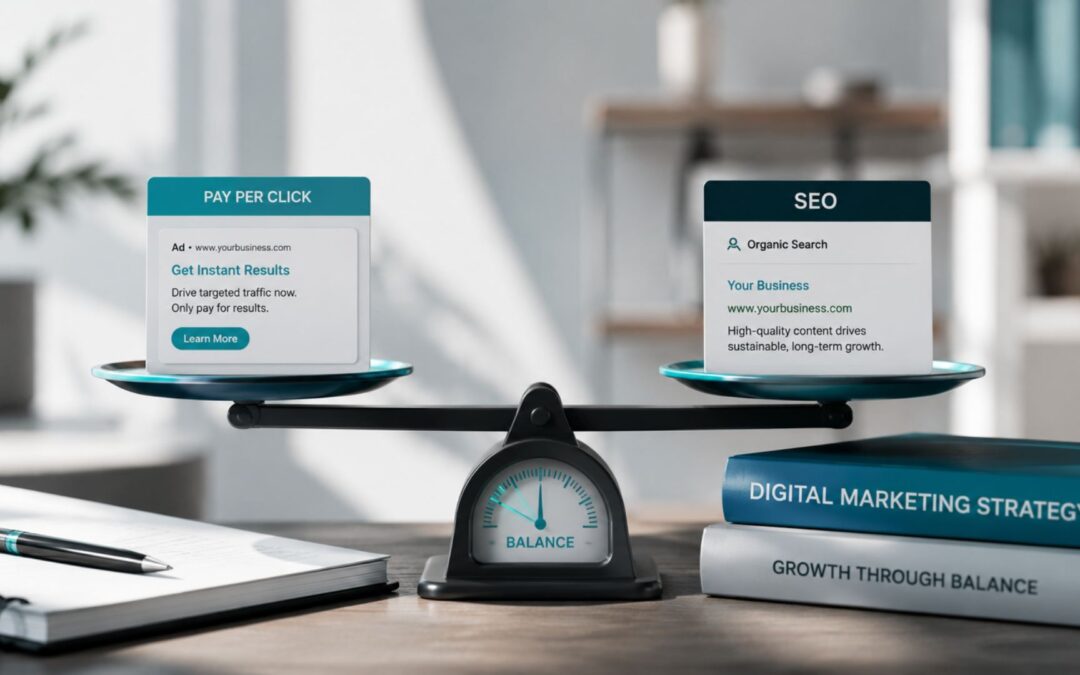
The paid ads versus SEO debate has been a fixture of digital marketing conversations for years, and it usually ends the same way: someone advocates strongly for one and dismisses the other based on a partial understanding of what each actually does.
The truth is that paid advertising and search engine optimization are not competing strategies. They are different tools built for different jobs, operating on different timelines, and producing different kinds of value. Choosing one over the other based on a general preference or a single budget conversation is almost always the wrong decision. Understanding when and why each makes sense, and how they amplify each other when used together, is what separates businesses that grow predictably from those that stay stuck in a cycle of either short-term wins with no foundation or long-term foundation with no short-term revenue.
For professional service firms, law practices, medical clinics, and businesses across Canada and the United States, this is not an academic question. The right answer directly determines how fast the business grows, how stable that growth is, and how much it costs to sustain.
Short-Term Acquisition Versus Long-Term Compounding Growth
The most fundamental difference between paid advertising and SEO is their relationship with time. Paid ads produce results immediately: launch a campaign today, get clicks and potentially consultations this week. Turn off the campaign, and the traffic stops. The value is real but it is entirely dependent on continued spend. The moment the budget is paused, the acquisition channel disappears.
SEO operates on a completely different timeline. A well-executed SEO strategy typically takes three to six months to begin showing meaningful results, and the full compounding impact of strong organic rankings, consistent content, and authority building takes one to two years to materialize. That timeline frustrates many business owners who are used to seeing results from paid channels quickly. But the payoff is structurally different. A website that ranks organically for high-value search terms continues to generate traffic and leads without additional spend on each click. The cost per acquisition from organic search decreases over time rather than increasing as competition drives up ad costs.
The practical implication is straightforward. A business that relies exclusively on paid ads to generate clients is renting its visibility. The moment it stops paying, it becomes invisible. A business that invests in SEO is building an asset that appreciates over time and reduces its dependence on paid channels. A business that does both is capturing the best of both timelines: immediate clients from paid search while building the organic foundation that will reduce acquisition costs for years to come.
“Paid ads are a faucet. Turn them on and water flows. Turn them off and it stops. SEO is a well. It takes time to dig, but once it is built, it produces water without being turned on every day.”
Demand Generation Versus Demand Capture
Paid ads and SEO also serve different roles in the demand journey, and understanding this distinction changes how both should be approached.
Demand capture is about appearing in front of someone who already knows they need help and is actively searching for it. Google Ads and organic SEO both operate in demand capture mode when they respond to specific search queries. A person who types “divorce lawyer in Ottawa” or “sports medicine clinic near me” has already decided they need the service. The competition is for who appears most credibly in that moment of intent.
Demand generation is about creating awareness and interest among people who are not yet actively searching. Social media advertising, display campaigns, and content marketing are the primary demand generation tools. They reach audiences who have not yet typed a query but who fit the profile of the ideal client. Over time, demand generation builds the pool of people who will eventually search, increasing the volume of demand that capture channels can then collect.
For most professional service firms, demand capture through paid search and organic SEO should be the priority because the intent is already there: people are searching for exactly what the firm offers. Demand generation through social advertising and content builds brand familiarity that makes demand capture more efficient over time, because a person who has seen the firm’s content before they searched is more likely to click on its result when they do.
The integrated strategy combines both: paid search and SEO to capture high-intent demand now, and social content and brand building to expand the pool of future searchers while warming prospects who are not yet ready to act.
How Strong SEO Lowers Paid Ad Costs Over Time
One of the most underappreciated benefits of a serious SEO investment is its effect on the efficiency of paid advertising. The relationship between the two is not just additive. It is multiplicative in the right conditions.
The mechanism works through Google’s Quality Score system. Quality Score is determined in part by the relevance and experience of the landing page a paid ad leads to. A website with strong organic authority, well-structured content, and high user engagement metrics, which are all outcomes of good SEO, tends to earn higher Quality Scores on its paid ads. Higher Quality Scores mean lower costs per click and better ad placement for the same bid. Businesses with strong SEO foundations are therefore getting more out of their paid ad budget than competitors with weak organic presence, even if the ad spend is identical.
There is also a brand recognition effect. A business that appears in both the paid and organic results for the same search query occupies more real estate on the search results page and benefits from the credibility signal that dual visibility provides. Research from Google has shown that appearing in both positions significantly increases overall click rate compared to appearing in either position alone. The SEO investment amplifies the paid ad performance, and vice versa.
Over time, as organic rankings improve and capture more traffic independently, the business can reduce its reliance on paid ads for the keywords it now owns organically and redirect that budget toward new terms, new geographies, or new service areas. The paid channel becomes more targeted and more efficient. The overall cost of client acquisition decreases. This is the compounding dynamic that makes the combined strategy more valuable than either channel alone.
Strategic Budget Allocation for Professional Service Firms
The question of how to split a marketing budget between paid ads and SEO does not have a universal answer, but there are strategic principles that apply consistently to professional service firms across North America.
For businesses in early growth mode or entering a new market where organic rankings have not yet been established, a higher allocation to paid search makes sense. Paid ads provide immediate visibility while the SEO foundation is being built. As organic rankings develop, the paid budget can be gradually rebalanced toward SEO maintenance and toward new paid opportunities in areas where organic presence has not yet caught up.
For established firms with existing organic traffic and stable rankings, the calculus shifts. SEO maintenance and content investment become the priority because they protect and extend the existing asset. Paid advertising is deployed tactically: for high-competition terms where organic ranking is difficult, for new service lines not yet covered organically, for seasonal campaign windows, and for geographic expansion into markets where organic presence has not been built.
A useful framework for professional service firms considering budget allocation:
- Phase one (months one through six): Invest significantly in paid search to generate immediate leads. Simultaneously begin SEO with keyword research, on-page optimization, and content development. Expect SEO to begin contributing meaningfully in month three to six.
- Phase two (months seven through twelve): Maintain paid search at a level that keeps the pipeline full. Increase SEO investment as rankings develop and organic traffic begins to produce leads. Begin identifying terms where organic ranking is approaching page one and where paid spend can be reduced.
- Phase three (year two and beyond): Organic search is contributing meaningfully to lead volume. Paid ads are concentrated on high-competition terms, new geographies, and new service lines. The combined cost per acquired client is lower than in phase one because the SEO asset has matured.
This phased approach requires a medium-term commitment that many businesses are reluctant to make. But the alternative, cycling through paid-only campaigns indefinitely without building an organic foundation, is a more expensive long-term strategy that never reduces acquisition costs and creates permanent channel dependency.
Integration Benefits and the Risk of Channel Dependency
The strongest argument for running paid ads and SEO simultaneously is not just the additive revenue from two channels. It is the risk management benefit of not being entirely dependent on either one.
Businesses that rely exclusively on paid ads face a specific vulnerability: cost volatility. When competitors increase their bids in a contested market, the cost per click for every firm in that market goes up. A firm with a $5,000 monthly Google Ads budget that was generating 20 leads per month may find that the same budget generates 14 leads a year later as competition intensifies. There is no buffer against this trend for a business with no organic presence, because the organic channel that could absorb some of the demand is not there.
Businesses that rely exclusively on organic SEO face a different vulnerability: algorithm dependency. Google updates its search algorithms regularly, and each major update has the potential to shift rankings meaningfully. A firm that ranks well organically but has no paid presence has no immediate fallback when a ranking drops. A firm running both channels can maintain client acquisition through paid search while addressing any organic ranking issues, rather than experiencing a revenue gap during the recovery period.
Integration also means that the data from each channel improves the other. Paid search data reveals which keywords convert best, informing which terms to prioritize in SEO. Organic traffic data reveals which content topics attract the most engaged visitors, informing which themes to incorporate into paid ad copy and landing pages. Shared conversion tracking means both channels are optimized toward the same business outcome rather than toward channel-specific vanity metrics.
How AI Is Shaping Both Organic and Paid Discovery
The rise of AI-powered search tools and AI-driven advertising platforms is reshaping both SEO and paid search in ways that reinforce the case for integration rather than separation.
On the organic side, AI search tools including ChatGPT, Google’s AI Overviews, and Perplexity are changing how users discover and evaluate professional service providers. These tools do not just return links. They synthesize information from multiple sources and generate recommendations. A professional service firm that ranks well organically, maintains consistent information across directories and platforms, and publishes structured, credible content is far more likely to be surfaced in an AI-generated recommendation than one that does not. Strong SEO and Answer Engine Optimization (AEO) practices directly improve AI discovery, which is becoming an increasingly significant source of inbound inquiries.
On the paid side, Google’s AI-powered bidding systems including Target CPA and Performance Max are making campaign management more sophisticated and more dependent on quality data inputs. These systems optimize toward conversion outcomes rather than click volume, but only when they have enough accurate conversion data to learn from. A business with strong SEO-driven organic traffic and well-configured conversion tracking across both channels provides the AI bidding systems with richer data, which produces more efficient paid ad performance.
The firms that will benefit most from AI advancement in both search and advertising are the ones that have invested in the underlying infrastructure: quality content, structured websites, accurate tracking, and consistent digital presence across all platforms. These investments serve organic search, paid search, and AI discovery simultaneously. The channel distinction matters less than the quality of the foundation beneath it.
For professional service firms across Canada and the United States, the implication is clear. AI is not replacing the need for strategic marketing investment. It is raising the stakes for businesses that have built that investment correctly, because the compounding benefits of a strong foundation are being amplified by AI systems that favor exactly what good SEO and well-managed paid advertising have always required: relevance, authority, and clarity.
References
- (2026). About Quality Score: How organic authority and landing page experience affect paid ad costs. support.google.com
- (2024). The combined effect of organic and paid search results on click-through rates. think.google.com
- (2025). How long does SEO take? A realistic timeline for organic search results. ahrefs.com/blog
- (2025). Domain authority and the compounding value of long-term SEO investment. moz.com
- Search Engine Journal. (2026). Paid ads vs organic SEO: How to allocate budget for maximum ROI in professional services. com
- (2025). The state of marketing: How integrated search strategies outperform single-channel approaches. hubspot.com
- (2025). Organic search versus paid: Channel performance and integration benchmarks for professional services. brightedge.com
- SocialEyes Communications. (2025). SEO in 2026 Is About Authority, Not Keywords. com
- SocialEyes Communications. (2025). Google Ads vs. Meta Ads: Which Platform is Best for Legal Campaigns? com
- SocialEyes Communications. (2026). How AI Search Is Changing How Customers Find Businesses. com
- SocialEyes Communications. (2025). No Tricks, Just a Google Strategy That Actually Works. com
The Bottom Line
Paid ads and SEO are not rivals. They are complements, and the most effective marketing strategies for professional service firms treat them that way. Paid search provides immediate demand capture and keeps the pipeline full while organic authority is being built. SEO builds a compounding asset that reduces acquisition costs over time and provides resilience against the cost volatility that paid-only strategies face. Together, they create a dual-channel system where each makes the other more effective.
The businesses that choose one and ignore the other are either renting visibility indefinitely through paid ads with no equity building, or building a strong organic foundation that takes years to pay off without the short-term revenue that paid search could have provided along the way. Neither of those approaches is wrong in every situation, but for most professional service firms with growth objectives, the integrated strategy is the one that produces the best long-term outcome.
As AI continues to reshape both organic and paid discovery, the quality of the underlying digital foundation determines who benefits most. Strong content, accurate tracking, consistent authority signals across all platforms, and a clear positioning that AI tools can understand and recommend: these are the investments that serve every channel simultaneously and compound in value as the landscape evolves.
Ready to Build a Search Strategy That Works on Both Timelines?
At SocialEyes Communications, we build integrated paid search and SEO strategies for law firms, medical practices, and professional service businesses across Canada and the United States. We do not pick a side in the paid versus organic debate. We build the right combination of both based on where your business is today, where you want to be, and what your timeline and budget make possible.
From Google Ads campaign management and landing page optimization to SEO content strategy, authority building, AEO, and full-funnel attribution, we build search strategies designed to produce clients now and compound in value over time.
If you have been running one channel without the other, or running both without a clear integration strategy, we can show you what the combined approach looks like for your specific business.
Website: www.socialeyescommunications.com
Email: info@socialeyescommunications.com
Phone: 1-888-762-1285
by Marly Broudie | Mar 31, 2026 | Search Engine Optimization
If you have been in business for more than a few years, you have probably felt the ground shift under “how people find you” at least once. First it was websites. Then Google. Then social. Then paid ads. Then reviews. Now it is AI.
So it makes sense that business owners are asking questions like: Is SEO dead or evolving in 2026? Why is SEO outdated? Is SEO dying due to AI? Is SEO being phased out?
The short answer is that SEO is not dead. It is changing fast. And more importantly, SEO on its own is no longer enough to win visibility the way it used to.
In 2026, visibility is built across an ecosystem, not a single channel. Your website, content, PR, reviews, and social presence all influence whether people trust you, whether Google recommends you, and whether AI tools include you in answers.
This is not bad news. It is an advantage for businesses that adapt early, because most competitors are still stuck in the old mindset of “just rank higher.”
Why SEO Alone Is No Longer Enough
SEO still matters. Search traffic still converts. Google still drives a huge portion of discovery.
But the path to discovery is no longer linear.
A modern buyer might hear about you on LinkedIn, check your reviews, search your name, scan your website, ask an AI tool to compare options, then come back days later to book. SEO alone cannot carry that journey because SEO is only one input in a bigger trust decision.
This is why some people assume SEO is outdated. What is actually outdated is the idea that SEO is only about keywords and rankings. In 2026, SEO is tied to trust signals, brand consistency, and authority across the web.
So when someone asks, Is SEO being phased out? the better question is: phased out by what? AI still relies on signals from the same ecosystem SEO has always lived in: websites, content, mentions, and reputation. SEO is evolving into something broader, and visibility requires you to evolve with it.
The Visibility Stack: Website, Content, PR, Social, and Reputation
Think of visibility like a stack. Each layer supports the next. If you only invest in one layer, you will hit a ceiling.
Your website is still the home base
Your website is where trust gets confirmed. It does not have to be flashy, but it does have to be clear. Visitors should quickly understand who you help, what you do, what outcomes you deliver, and why you are credible. If your website is vague, the rest of your marketing has to work harder.
Content builds authority and relevance
Content is not just “blogs for SEO.” It is how you answer real questions, show expertise, and earn long-term discoverability. In 2026, helpful content does two things: it supports Google rankings through topical depth, and it supports AI summaries by providing clear, structured answers.
PR and third-party mentions are trust accelerators
Third-party validation is now a major driver of visibility. A mention in an industry publication, an association feature, a guest interview, or a partner collaboration can influence credibility, brand searches, backlinks, and how AI tools interpret your reputation. PR does not need to mean national news. Niche credibility often carries more weight.
Social is proof, not just reach
For many buyers, social is where they validate that you are real and consistent. You do not need to post daily, but you do need to show signs of life: recent updates, clear positioning, examples of work, and a tone that matches your brand.
Reviews and reputation are part of visibility
Reviews are not just a conversion tool anymore. They influence whether you are considered at all, and they shape what AI tools might summarise about you. If your reputation strategy is passive, your visibility will be inconsistent.
Visibility as a Competitive Advantage
In 2026, visibility is not just marketing. It is leverage.
The businesses that are easy to find and easy to trust will win more often, even if they are not the cheapest option. Visibility reduces friction, shortens sales cycles, improves lead quality, and helps buyers feel confident sooner.
A brand that shows up consistently across search, AI answers, social, and third-party sources feels like the safer choice. That is a competitive advantage you can build deliberately.
Is SEO Dying Due to AI? Not Exactly
AI is changing search behaviour, but it is not killing SEO. It is changing what “good SEO” looks like.
People who ask Is SEO dying due to AI? are usually noticing fewer clicks from informational searches, more answers appearing directly in results, and AI summaries reducing the need to open multiple tabs.
Those shifts are real. But they do not remove the need for visibility. They increase the importance of authority. If AI answers the easy questions, your brand still needs to be the one that gets recommended when someone is ready to act.
So when someone asks, Is SEO dead or evolving in 2026? the answer is evolving, and it is expanding into a broader visibility strategy.
Why Brands That Adapt Early Will Win
Most businesses are still thinking in single-channel terms: “We need more traffic,” “We need to rank higher,” “We need to post more,” “We need to run ads.”
The brands that win will be the ones that connect the dots and build a system where each channel supports the others:
- content makes PR stronger
- PR drives backlinks and brand searches
- social validates credibility
- reviews increase trust and conversion rate
- your website ties everything together and converts attention into action
Early adopters benefit because the competitive bar is still low in many industries. Most brands are not building for AI-driven discovery yet.
How Businesses Should Rethink Marketing Investment
A lot of businesses treat marketing like separate line items: some SEO spend, occasional ads, sporadic content, and social when there is time.
In 2026, the better approach is to invest in assets that compound. Instead of asking “what channel should we spend on,” ask:
- what makes us easier to trust?
- what makes us easier to understand?
- what makes us easier to find across platforms?
That mindset leads to smarter priorities:
- strengthen core website pages and positioning
- publish fewer, better pieces of content aligned with services
- build third-party credibility through PR and partnerships
- maintain a consistent social presence that supports trust
- actively grow and manage reviews
This is how you build visibility that does not disappear the moment you pause ad spend.
A Forward-Looking Perspective on Discovery and Trust
Discovery is becoming more assisted. Buyers are leaning on AI tools, summaries, social proof, and third-party validation to make decisions faster.
Trust is becoming the real currency of visibility.
SEO is still part of the equation, but it is now one piece of a larger puzzle. If you want to win in 2026 and beyond, build an ecosystem where people can find you, understand you, and trust you at every step.
Call to Action
If you are wondering whether SEO is still worth investing in, the answer is yes, but not as a standalone tactic.
If you want a practical visibility strategy that blends SEO, content, PR, and social into one cohesive system, contact SocialEyes. We help businesses build authority and trust across the channels that matter now, so you are not just visible today, but consistently discoverable in the future.

by shahzaib khan | Mar 31, 2026 | Search Engine Optimization
For years, the advice was straightforward: build a good website, do some SEO, and you will be discoverable.
That is still important, but it is no longer the full picture.
In 2026, your website is not the only place people (or AI tools) learn about your business. Large language models and AI-driven search experiences are pulling information from a much wider ecosystem. They are looking at your digital footprint as a whole, then deciding what to surface, summarize, or recommend.
This shift catches a lot of businesses off guard. They assume that if their website looks polished and their service pages are solid, they will “show up” in AI-generated answers. Sometimes they do. But increasingly, AI visibility is influenced by the same thing humans rely on when they are unsure: third-party validation.
That is why your website is necessary, but not sufficient.
Let’s break down where AI pulls business information from, why it matters, and how to build a presence that holds up in an AI-driven discovery world.
How Large Language Models Gather Information
Large language models do not “think” like humans, and they do not browse the web the way a person does in a normal session. But they still need information sources to generate useful answers.
Depending on the tool and the context, AI systems may rely on a combination of:
- training data that includes publicly available web content (captured at specific points in time)
- licensed or partnered data sources
- live web retrieval or search integrations
- structured databases and knowledge graphs
- user-provided context, prompts, and documents
What matters for businesses is the outcome: AI answers are often a blend of what the model has learned historically and what it can confirm through current, reputable sources.
This is why your online presence cannot depend on one channel. If you want AI tools to understand who you are and trust what you claim, you need signals across multiple places.
Why AI Pulls From Multiple Online Sources
If your website says you are the best option, that is a claim. AI systems, like human searchers, look for validation.
When AI tools generate answers about businesses, they are trying to reduce risk. They want to avoid recommending something inaccurate, low quality, or misleading. One of the easiest ways to do that is to cross-check information across sources.
This is why AI pulls from multiple places, such as:
- business directories and listings
- reputable news sites and industry publications
- social proof and brand mentions
- professional association websites
- government or regulatory databases (where relevant)
- forums, Q and A sites, and community discussions
If your website says one thing but other sources say something different, AI tools may hesitate, summarise you inaccurately, or leave you out entirely.
Why Your Website Isn’t Enough on Its Own
Your website is the one place you fully control. That is exactly why it is not the only input AI will use.
A business can publish anything on its own site. AI systems know that. So when your website makes claims, AI needs supporting evidence elsewhere to treat those claims as reliable.
This matters even more for industries where trust is high-stakes, like legal, medical, and financial services. In those spaces, AI tools often weigh reputation and third-party validation more heavily because the cost of a bad recommendation is higher.
A strong website is the foundation. But your digital footprint is the proof.
The Importance of PR, Features, and Third-Party Mentions
Third-party mentions are one of the strongest trust signals online, for both Google and AI-driven search.
When a reputable publication, podcast, industry blog, or association mentions your business, it creates a signal that you exist beyond your own marketing.
- media features and interviews
- guest articles in reputable publications
- conference speaker listings
- association memberships and directory listings
- partner pages and collaborations
- citations in industry research or roundups
PR does not have to mean national press. In many cases, niche and industry-specific mentions are more valuable because they align with your target audience and category.
If you serve a local market, local press and community partnerships can be powerful. If you serve a specialised sector, a mention in a respected industry publication can carry outsized weight.
The key is that third-party sources act like external references. They help AI tools treat your business as credible, established, and relevant.
How Reviews and Reputation Factor Into AI Trust
Reviews are not just a conversion tool anymore. They are a visibility tool.
AI systems use reputation as a shortcut for trust. When they see consistent positive feedback across reputable review platforms, it reduces uncertainty about recommending a business.
- validating what you actually do
- confirming service areas and specialties
- highlighting patterns in client experience
- surfacing strengths and differentiators in natural language
This is especially important because reviews are written in the same conversational style people use in AI search. They often include context, outcomes, and specific scenarios. That makes them valuable input for AI summarisation.
The takeaway: if your review strategy is inconsistent, your AI visibility will be inconsistent too.
Why Consistency Across Platforms Matters
One of the fastest ways to create confusion for search engines and AI tools is inconsistent information.
Common consistency issues include:
- different service descriptions on different platforms
- outdated addresses or phone numbers on directory listings
- mismatched brand names (for example, “ABC Law” vs “ABC Law Group” vs “ABC Legal”)
- inconsistent hours, service areas, or offerings
- conflicting claims about specialties or credentials
AI systems are constantly trying to reconcile these differences. If they cannot, they may present partial information, or avoid making a recommendation.
Consistency is not about copying and pasting the same text everywhere. It is about ensuring the core facts and positioning match across your digital footprint.
This includes your website, Google Business Profile, LinkedIn, industry directories, and any other platform where your business appears.
Building a Complete Digital Footprint
If you want to increase your chances of being accurately represented in AI-generated answers, you need to think beyond your website and build a complete footprint.
Here is what that typically includes:
A clear, well-structured website
Your website is still your home base. It should clearly explain who you help, what you do, and why you are credible. It should also make it easy to confirm basic business information.
Strong listings and profiles
Make sure your Google Business Profile, LinkedIn page, and key directories are accurate, updated, and aligned with your website.
Reputation and reviews
Build a steady stream of genuine reviews on the platforms that matter for your industry. Respond professionally. Keep it consistent.
Third-party validation
Pursue mentions that make sense for your market. This could be local press, industry podcasts, association features, awards, guest articles, or strategic partnerships.
Content that demonstrates real expertise
Blogs, guides, FAQs, and resources that answer real client questions help AI tools understand your niche and your perspective. This also supports your broader visibility in both traditional search and AI-driven experiences.
Ongoing monitoring
Your footprint is not something you build once. It needs maintenance. Businesses change, teams evolve, services shift, and platforms update. The more consistent you stay, the more trustworthy you appear.
The Bottom Line
AI is changing how customers discover businesses, but it is also changing how businesses are evaluated.
Your website is essential, but AI visibility is shaped by what the rest of the internet says about you too.
If you want to be accurately represented in AI-generated answers, you need a complete digital footprint: a strong website, consistent listings, credible third-party mentions, and a reputation that matches your positioning.
Call to Action
If you are not sure what AI tools are pulling about your business, or you want a plan to strengthen your digital footprint, contact SocialEyes. We help businesses build authority through clear website messaging, reputation strategy, and third-party visibility, so you show up consistently and credibly wherever customers are searching.
