
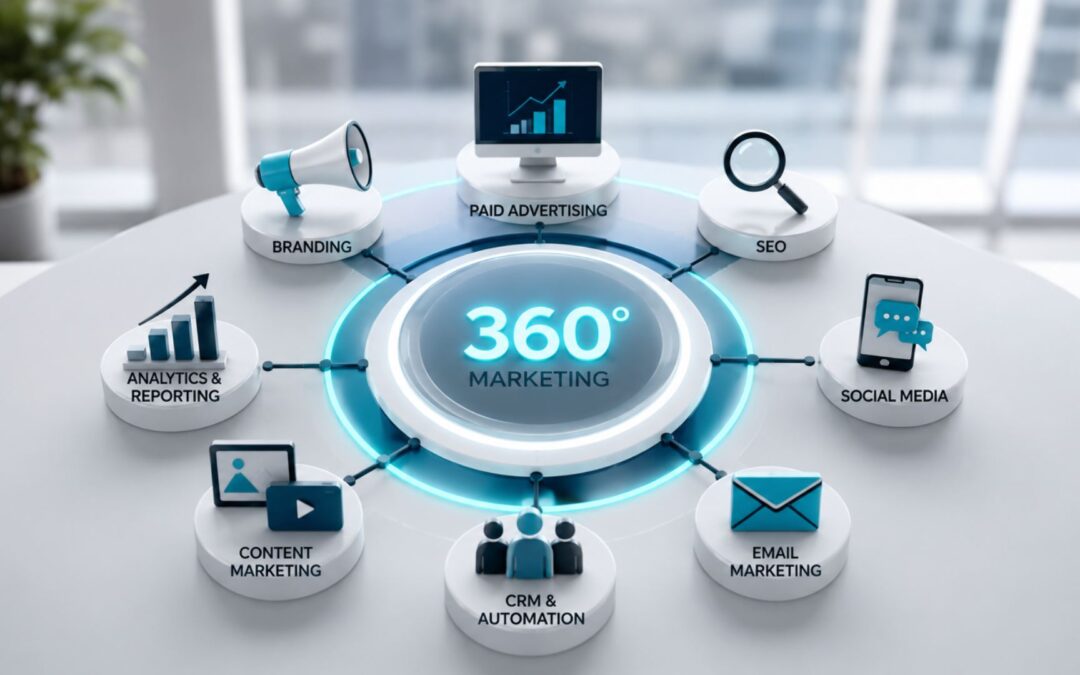
The phrase “360 marketing” gets used often. It appears in agency decks, onboarding documents, and strategy presentations across the industry. But ask most business owners what it actually means in practice, and you will get a vague answer about being present on multiple platforms.
That is not a 360 marketing model. That is a presence checklist. Running a Google Ads campaign, posting on Instagram, and maintaining a website are three separate activities. A 360 marketing model is something fundamentally different: a connected system in which every component informs, supports, and amplifies every other component, and in which the data flows between them in a way that makes the whole measurably greater than the sum of its parts.
For law firms, medical practices, and professional service businesses across Canada and the United States, the difference between a collection of marketing tactics and a true integrated marketing system is the difference between spending on marketing and investing in it. This blog breaks down what a real 360 marketing model looks like, how each component connects, and why building it correctly is one of the most important strategic decisions a professional service business can make.
Why Isolated Tactics Fail Long-Term
Most businesses start their marketing journey by adding tactics one at a time. They build a website. Then they run some ads. Then someone suggests they start an SEO program. Then they get a CRM. Each of these is added in response to a specific need, managed by a different person or vendor, and evaluated on its own metrics.
The result is a set of marketing activities that are technically running simultaneously but are not actually working together. The Google Ads campaign is sending traffic to a website that was not designed to convert paid visitors. The SEO program is producing content that nobody in the CRM system is following up on. The social media posts have no connection to the landing pages the ads are using. Each channel is doing its job in isolation, and none of them is doing it as well as it could if they were coordinated.
The strategic cost of this fragmentation compounds over time. Budgets get allocated by channel rather than by business objective. Reporting happens by platform rather than by revenue outcome. And when something is not working, the problem is nearly impossible to diagnose because nobody has a complete view of the funnel from first impression to retained client.
Isolated tactics also create channel dependency, which is one of the most significant risks in professional services marketing. A firm that relies entirely on Google Ads for new client acquisition is one algorithm update or cost spike away from a revenue gap. A firm with an integrated system has redundancy built in: if one channel underperforms, others absorb the demand while the issue is addressed.
What the 360 Model Actually Integrates
A fully integrated 360 marketing model for professional service firms connects five core components into a single system. Each has a distinct role, but none functions optimally without the others.
The Website: The Central Hub
The website is not a component of the marketing system. It is the hub that everything else connects to and flows through. Every ad campaign drives traffic to it. Every SEO effort is built on its structure and content. Every CRM lead originates from a conversion event on it. Every analytics report is anchored to what happens on it.
A website built for a 360 model is designed from the outset to serve all of these functions simultaneously. It has the conversion architecture to turn paid traffic into consultations, the content depth to rank organically for high-value search terms, the structured data and credential display to satisfy AI trust signals, and the tracking infrastructure to feed accurate data into every other component of the system.
SEO and AEO: Compounding Organic Visibility
Search engine optimization builds the long-term organic authority that reduces dependence on paid traffic over time. In an integrated system, SEO informs which keywords are worth targeting in paid campaigns, which content topics attract the most qualified visitors, and which service pages need strengthening to improve both organic and paid conversion rates.
Answer Engine Optimization (AEO) extends this to AI-powered search tools including ChatGPT, Google AI Overviews, and Perplexity. A well-structured website with clear credentials, specific service descriptions, and natural-language FAQ content is far more likely to be surfaced in an AI-generated recommendation than one without these elements. In an integrated model, the content created for SEO simultaneously serves AEO, because the signals both channels favor are largely the same: specificity, authority, and clarity.
Paid Advertising: Immediate Demand Capture
Google Ads and Meta Ads capture demand and generate leads in the short term while organic authority is building. In an integrated system, the data from paid campaigns feeds the SEO strategy by revealing which search terms convert at the highest rate. The organic content strengthens ad Quality Scores by improving landing page relevance. The CRM data flowing back into the ad platforms improves audience targeting by telling the algorithms which types of leads actually became clients.
CRM and Intake: Closing the Loop
The CRM is where marketing stops being an expense and becomes a revenue measurement system. In an integrated 360 model, every lead entering the CRM is tagged with its source campaign, the specific ad or search term that generated it, and the page it converted on. As leads move through the intake process, the CRM tracks which ones become consultations, which become retained clients, and what the revenue value of each is.
That data flows back into every other component. The ad platforms use it to optimize toward the audiences that produce the best clients, not just the most clicks. The SEO strategy uses it to prioritize the content that produces qualified visitors. The website uses it to identify which pages have the highest and lowest conversion rates.
Analytics: The Connective Tissue
Analytics is what turns data from five separate channels into a single, coherent picture of how marketing investment translates into revenue. In an integrated system, Google Analytics 4 is connected to the ad platforms, the CRM, and any call tracking software in use, so that the reporting can show not just traffic and clicks but consultations booked and clients acquired by source, campaign, and keyword.
Without this layer, the system produces data but not intelligence. With it, the business can answer the questions that matter: which channels are producing the best return, where in the funnel leads are being lost, and how to allocate next month’s budget to produce the most efficient growth.
Authority Stacking and Why It Improves Every Channel
One of the least discussed but most powerful dynamics in an integrated marketing system is authority stacking. This is the cumulative effect of a professional service firm’s credibility signals appearing consistently across multiple platforms and formats, reinforcing each other and compounding the trust that both humans and algorithms assign to the firm.
A law firm that has been featured in a legal publication, holds a Martindale-Hubbell rating, appears in Google’s local pack, maintains a well-reviewed Google Business Profile, publishes regular thought leadership content, and is referenced on relevant third-party directories is not just more credible than a firm with only a website. It is more likely to be recommended by AI search tools, more likely to earn higher Quality Scores on its paid ads, more likely to appear in the top organic results for competitive search terms, and more likely to convert visitors because the trust signals are already in place before the visitor even reads the homepage.
Authority stacking is built deliberately, not accumulated accidentally. In a 360 marketing model, the PR and recognition strategy, the content strategy, the directory and citation management, and the social media presence are all coordinated toward the same outcome: a digital footprint that is wide, consistent, and credible enough that both people and AI platforms encounter it and recommend the firm with confidence.
Revenue Forecasting Based on Marketing Inputs
One of the defining capabilities of a fully integrated 360 marketing system is the ability to forecast revenue from marketing inputs with meaningful accuracy. This is not possible with isolated tactics, because the data required to build the forecast does not exist in a form that connects across the funnel.
When the system is fully connected, the inputs are knowable. Monthly website traffic, paid and organic conversion rates, lead-to-consultation conversion rates, consultation-to-client conversion rates, and average client lifetime value can all be tracked accurately. With those numbers in hand, a business can model the expected revenue from any given level of marketing investment with a degree of confidence that transforms budget conversations from debates about spend to discussions about growth objectives.
The practical result is that marketing becomes a lever rather than a gamble. The firm knows that increasing its Google Ads budget by $2,000 per month, based on current conversion data, should produce approximately X additional consultations. It knows that improving the website conversion rate by one percentage point should produce Y additional leads from existing traffic without any additional spend. These are not guarantees, but they are evidence-based projections that make strategic planning far more rational than it is for businesses operating without this infrastructure.
“When marketing data connects all the way from the first click to the signed engagement, budgeting decisions stop being opinions and start being calculations.”
AI Analytics and Optimization in an Integrated System
AI is not replacing the integrated marketing model. It is amplifying it. And the businesses that benefit most from AI-powered marketing tools are the ones that have already built the data infrastructure for those tools to learn from.
AI-powered bidding in Google Ads and Meta Ads optimizes campaign performance in real time based on conversion signals. These systems work best when they have access to rich, accurate conversion data from a CRM-connected funnel rather than just form submissions on a website. A firm whose CRM feeds actual client acquisition data back into the ad platforms is giving the AI significantly better inputs, which produces significantly better outputs.
AI analytics platforms can now surface patterns in marketing data that human analysts would miss or take weeks to identify. Which combination of first touch channel, content type, and follow-up speed produces the highest consultation-to-client conversion rate? Which audience segments are showing early behavioral signals that historically precede conversion? These are questions that AI analytics tools can answer automatically when the data infrastructure is in place.
Predictive analytics is the frontier of this capability. AI tools are increasingly able to forecast which leads in the current pipeline are most likely to convert, which marketing channels will produce the most efficient growth in the next quarter based on seasonal patterns and historical performance, and which website pages are likely to improve in ranking if targeted for additional content investment. For professional service firms across Canada and the United States, these capabilities are available now through platforms like Google Analytics 4, HubSpot, and Salesforce Einstein, and the firms building their data infrastructure correctly are the ones positioned to use them.
Frequently Asked Questions
What is a 360 marketing model for professional services?
A 360 marketing model is an integrated system in which a professional service firm’s website, SEO, paid advertising, CRM, and analytics all share data and inform each other rather than operating as separate campaigns. The defining feature is that every channel feeds into and strengthens every other channel, producing compounding results that isolated tactics cannot replicate.
How long does it take to build a fully integrated marketing system?
A basic integrated system including conversion tracking, CRM connection, and aligned ad and SEO strategies can be built in sixty to ninety days. Full integration with AI-powered analytics, authority stacking, and revenue forecasting capability typically matures over six to twelve months as the data accumulates and the system learns from it. [VERIFY: confirm these timelines reflect SocialEyes’ actual client experience]
Can a small law firm or medical practice afford a 360 marketing approach?
Yes. A 360 marketing model is a strategic framework, not a budget threshold. A firm with a modest marketing budget can still integrate its website, a focused SEO program, one primary paid channel, a basic CRM, and Google Analytics 4 into a connected system. The integration produces better returns at any budget level than the same spend deployed across disconnected tactics.
How does a 360 marketing model help with AI search visibility?
AI search tools including ChatGPT, Google AI Overviews, and Perplexity favor sources that are specific, structured, consistent, and credible across multiple platforms. An integrated 360 marketing model builds exactly these signals through coordinated SEO and AEO content, consistent directory and citation management, authority stacking through PR and awards, and a website structured to communicate expertise clearly. The result is a digital footprint that AI platforms are more likely to recommend.
What is the difference between a 360 marketing model and just running multiple channels?
Running multiple channels means operating separate campaigns that happen to exist at the same time. A 360 marketing model means those channels share data, coordinate their messaging, and each makes the others more effective. The defining test is whether the data from one channel is actively improving the performance of another. If it is not, it is not a 360 model. It is a collection of tactics.
How does CRM integration change the way marketing performs?
CRM integration closes the loop between marketing spend and revenue outcome. Without it, marketing data stops at the lead submission. With it, the system can track which campaigns, channels, and keywords produced retained clients and what those clients were worth. That data flows back into the ad platforms to improve targeting, into the SEO strategy to prioritize high-converting content, and into budget allocation decisions to concentrate spend where it produces the best clients, not just the most clicks.
References
- (2026). Google Analytics 4: Cross-channel attribution and conversion measurement. support.google.com
- (2026). About Smart Bidding: How machine learning uses conversion data to optimize campaign performance. support.google.com
- (2025). The State of Marketing Report: Integrated marketing, CRM alignment, and revenue attribution. hubspot.com
- (2025). State of Marketing: How AI analytics and CRM integration improve campaign performance and revenue forecasting. salesforce.com
- Search Engine Journal. (2026). Answer Engine Optimization: How structured content and authority signals improve AI search visibility. com
- (2025). Domain authority and the compounding effect of cross-platform citation consistency. moz.com
- McKinsey and Company. (2025). The data-driven enterprise: How integrated analytics transforms marketing from cost center to revenue system. com
- SocialEyes Communications. (2025). From Clicks to Clients: How to Track Real ROI on Your Marketing Campaigns. com
- SocialEyes Communications. (2026). Why CRM Alignment Is the Missing Link in Most Marketing Strategies. com
- SocialEyes Communications. (2026). How AI Search Is Changing How Customers Find Businesses. com
The Bottom Line
A 360 marketing model is not a buzzword or a budget category. It is a specific way of building and connecting marketing infrastructure so that every component makes every other component more effective. The website serves the ads. The ads serve the SEO. The CRM serves the ad platforms. The analytics serve all of them. And authority stacking makes the whole system more credible to both human prospects and AI search tools simultaneously.
Professional service firms that operate from this model do not just market more efficiently. They grow more predictably. They can forecast revenue from marketing inputs, diagnose where the funnel is underperforming, and allocate budget with a degree of rational confidence that is simply not available to businesses running disconnected tactics.
The tools required to build this system exist and are accessible to firms of every size across Canada and the United States. What most firms are missing is not the technology. It is the strategic framework to connect it all correctly and the commitment to maintain it as an integrated system rather than reverting to the convenience of managing each channel in isolation.
Find Out If Your Marketing Channels Are Working Together or Working Against Each Other
At SocialEyes Communications, we audit and rebuild marketing systems for law firms, medical practices, and professional service businesses across Canada and the United States. We assess how your current website, SEO, paid ads, CRM, and analytics are connected, identify where data is being lost between channels, and build the integrated infrastructure that turns disconnected marketing spend into a measurable revenue system.
If you have been running campaigns without a clear picture of what each one is actually contributing to your bottom line, a marketing system audit is the right starting point. We can show you exactly where your current setup is costing you clients you already paid to reach.
Website: www.socialeyescommunications.com
Email: info@socialeyescommunications.com
Phone: 1-888-762-1285