
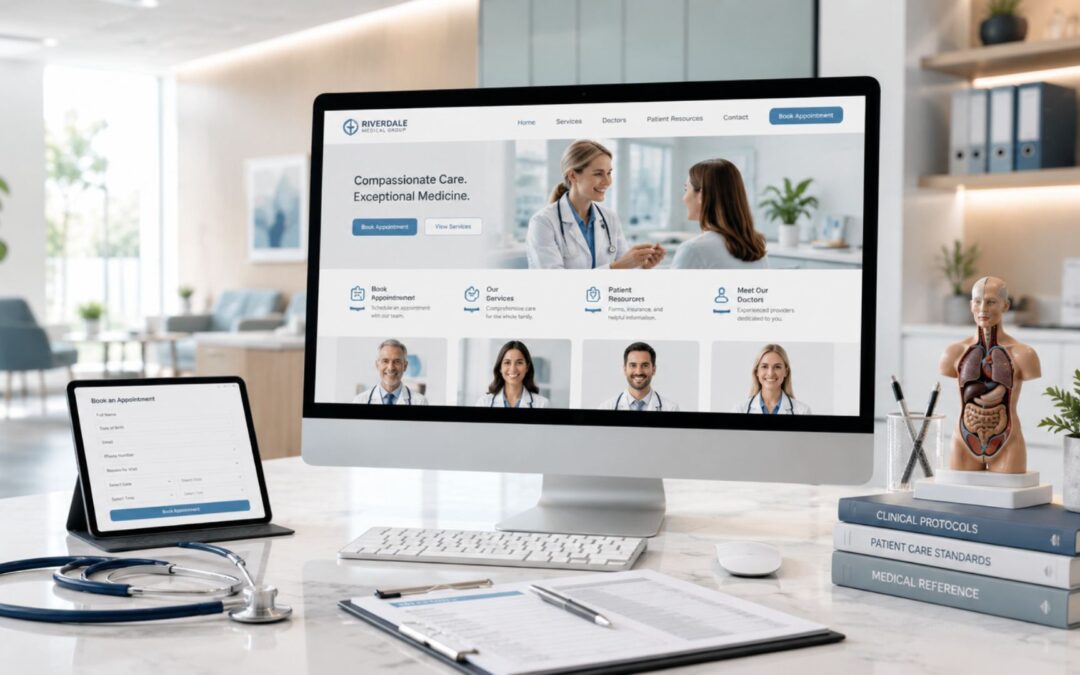
There is a moment that happens on almost every medical practice website. A potential patient lands on the homepage, scans for a few seconds, and makes a decision. Not about whether to book an appointment. About whether this practice feels trustworthy enough to keep reading.
That decision happens fast. Research from the Nielsen Norman Group suggests that users form an impression of a website within the first few seconds of viewing it. For medical practices, the stakes attached to that impression are higher than in most industries. A person researching a podiatrist, a family doctor, a specialist, or a clinic is not browsing casually. They are dealing with a health concern. They are looking for someone they can trust with their body.
High-performing medical practice websites understand this. They are not just designed to look clean and professional. They are built to communicate credibility, reduce anxiety, and make the path to booking as clear and frictionless as possible. Here is what they do that most practice websites do not.
Understanding Patient Psychology Online
Most healthcare decisions involve some level of fear or uncertainty. Whether a patient is seeking care for a chronic condition, a new symptom, or a routine procedure, they are arriving at your website with questions they may not even know how to articulate yet. They want to feel like they are in the right place before they will trust you with anything more.
High-performing medical websites are designed with this psychology at the center. Every element from the homepage headline to the provider bio to the FAQ section is written and structured to do one thing: reduce doubt and build confidence.
This starts with tone. Clinical language creates distance. Jargon may signal expertise to other professionals, but to a patient reading your website at 11pm trying to decide if they should call your office in the morning, it creates confusion and hesitation. The most effective medical practice websites write in plain language that is warm, direct, and respectful of the patient’s intelligence without requiring a medical degree to understand.
Clarity and reassurance are not soft marketing concepts. They are conversion tools. When a patient feels understood by your website, they are significantly more likely to take the next step.
“A patient searching for a specialist is not looking for the most technically impressive website. They are looking for the one that makes them feel like they are already in good hands.”
Clean Design Is Not the Same as Clear Messaging
This is one of the most important distinctions in medical website strategy, and it is one that many practices miss. A website can look beautiful, modern, and professionally designed and still fail completely at communicating what it needs to communicate.
Clean design means visual simplicity: white space, readable fonts, consistent colour palette, uncluttered layouts. These are valuable. But clean design is not a substitute for clear messaging. A homepage with a stunning full-screen image and a vague tagline like “Caring for Your Health” tells a patient almost nothing. It does not tell them what conditions the practice treats, who the providers are, where the clinic is located, or how to book an appointment.
High-performing medical websites pair clean design with structured, purposeful content. The visual presentation supports the message rather than replacing it. A patient should be able to arrive on the homepage and within a few seconds answer the following without scrolling:
- What does this practice specialize in?
- Who are the providers, and what are their qualifications?
- Is this clinic located in or near my area?
- How do I book an appointment or get in contact?
If a website cannot answer those four questions immediately, it is losing patients regardless of how polished it looks.
SEO Must Align With Patient Intent
Search engine optimization for medical practices is not simply about ranking for broad terms like “doctor near me” or “medical clinic.” Those terms generate traffic, but they rarely generate the right traffic. High-performing medical practice websites are built around patient intent: the specific conditions, treatments, and questions that the patients the practice actually wants to reach are typing into Google.
This means building out individual pages for each condition treated and each service offered. A podiatry clinic that treats plantar fasciitis, diabetic foot care, ingrown toenails, and custom orthotics should have a dedicated, substantive page for each of those services, not a single “Services” page with a short paragraph for each.
Location specificity matters enormously in healthcare SEO. Patients searching for medical care are almost always searching locally. Search terms like “podiatrist in San Diego,” “foot specialist near Hillsboro TX,” or “family medicine clinic in Mississauga” reflect how real patients search. A medical website that incorporates location-specific language naturally and accurately throughout its content will consistently outperform one that does not.
The alignment between SEO and patient intent also applies to FAQ content. The questions your front desk answers every day on the phone are the same questions patients are typing into search engines. Building FAQ sections that reflect those questions in natural, conversational language is one of the highest-return SEO investments a medical practice can make.
Trust Indicators That Actually Drive Bookings
In healthcare, trust is the deciding factor. A patient might find your website through a search, but they will not book an appointment until they believe you are qualified, experienced, and worth their time. High-performing medical practice websites are intentional about building that trust through specific, verifiable signals rather than generic claims.
The trust indicators that have the most measurable impact on booking rates include the following:
- Provider bios with real depth: Not just a name and credentials. Effective provider bios communicate where the provider trained, what they specialize in, their approach to patient care, and ideally something that makes them human and approachable. Patients are choosing a person, not just a credential.
- Certifications and affiliations prominently displayed: Board certifications, hospital affiliations, professional associations, and continuing education recognitions all signal credibility. These should be visible, not buried in a footer.
- Patient reviews integrated into the site: Third-party reviews from Google, Healthgrades, RateMDs, or similar platforms carry significant weight. Featuring them directly on the website, rather than only relying on patients to find them independently, increases their conversion impact.
- Process transparency: Patients are more likely to book when they know what to expect. Explaining what the first appointment looks like, how long it takes, what to bring, and what happens next removes the uncertainty that often prevents people from taking action.
- Before and after or outcome content where appropriate: For practices where visual results are relevant, such as dermatology, orthopedics, or podiatry, outcome photography builds confidence in a way that written content alone cannot.
None of these elements require a large budget to implement. They require intentionality about what matters to the patient and a commitment to communicating it clearly.
Website Structure That Supports Appointment Growth
A medical practice website is not a brochure. It is an intake system. Every page, every navigation decision, every call to action should be oriented around one outcome: getting the right patient to take the next step.
High-performing medical websites are structured around the patient journey rather than around the internal organization of the practice. This is a subtle but important distinction. Many practice websites organize their navigation around what makes sense internally, with tabs for “About,” “Services,” “Team,” and “Contact.” High-performing sites organize their navigation around how a patient actually thinks and moves through a decision.
That means:
- The most common patient entry points (specific conditions or treatments) are easy to find from the homepage
- Every service or condition page has a clear next step, whether that is a booking button, a contact form, or a phone number
- The booking or contact process itself is as simple as possible, with minimal required fields and fast confirmation
- Mobile experience is treated as the primary experience, not an afterthought, because the majority of healthcare searches now happen on mobile devices
- Page load speed is optimized, since slow-loading medical websites lose a significant share of potential patients before the page ever finishes rendering
Confusion at any point in the patient journey is lost revenue. High-performing websites reduce that confusion by making the right action obvious at every step.
Modern-Looking Does Not Mean Effective
This deserves its own section because it is one of the most expensive misconceptions in medical website investment. A practice invests in a redesign. The new site looks contemporary, the photography is beautiful, the animations are smooth. And then the phone does not ring any more than it did before.
The problem is that the redesign prioritized aesthetics over architecture. A modern-looking site that lacks clear positioning, structured content, and a functional intake pathway will underperform an older, plainer site that does those things well. Design is the vehicle. Content architecture is the engine.
The question to ask about any medical website is not “does this look good?” The question is “does this convert?” Those are different standards, and confusing them is a costly mistake.
A medical practice website should be evaluated on the following criteria, in addition to its visual presentation:
- Does the homepage communicate the practice’s specialization within the first five seconds?
- Are provider credentials visible and easy to find?
- Is there a clear, friction-free path to booking or contacting the practice from every page?
- Does the site perform well on mobile?
- Is the content written for the patient, not for the practitioner?
- Are there enough trust signals to give a new patient the confidence to take action?
A site that scores well on these criteria will consistently outperform a site that only scores well on visual presentation.
How AI Search Is Changing Patient Discovery
In 2026, a growing share of patients in both the United States and Canada are beginning their healthcare search not with a Google query but with a question asked directly to an AI tool. They are typing things like “what kind of doctor treats plantar fasciitis” or “who is a good podiatrist near me in Phoenix” into ChatGPT, Google’s AI Overviews, Perplexity, or other AI-powered search tools. The responses those tools generate are not simply lists of links. They are recommendations built from structured, credible information pulled from across the web.
This shift has significant implications for medical practice websites. AI search tools favor content that is specific, structured, and authoritative. They are looking for clear answers to clear questions. A medical website that is organized around conditions and treatments, that includes thorough provider bios with verifiable credentials, and that publishes FAQ content addressing the questions patients actually ask is far more likely to be surfaced in an AI-generated response than one with generic, vague content.
The signals that matter most for AI visibility in healthcare include:
- Condition and treatment pages that are thorough, specific, and written in natural language
- Provider bios that include credentials, specializations, education, and professional affiliations
- FAQ content structured around how patients phrase questions, not how practitioners do
- Consistent information across the practice website, Google Business Profile, Healthgrades, RateMDs, and other relevant directories
- Third-party mentions such as press features, medical association listings, and community recognition
Answer Engine Optimization (AEO) for medical practices is still a relatively new discipline, but the practices investing in it now are building discoverability that will compound as AI search becomes an increasingly central part of how patients find care. The foundation of AEO is simply this: be specific, be structured, and be credible. A medical website built on those principles is already most of the way there.
At SocialEyes Communications, we have worked with medical practices across North America to build digital presences that perform on both traditional search engines and the AI platforms that are increasingly shaping how patients find and choose their providers. The pattern is consistent: the practices that grow their patient base through digital channels are the ones that have invested in building the right infrastructure, not just the best-looking website.
References
- Nielsen Norman Group. (2024). How long do users stay on web pages? com
- Google Search Central. (2026). Creating helpful, reliable, people-first content. google.com/search
- (2025). How patients choose a doctor: Key trust factors in healthcare decisions. healthgrades.com
- (2025). Local Consumer Review Survey: Healthcare edition. brightlocal.com
- (2025). Local SEO for medical practices: A complete guide. moz.com
- (2026). Mobile-first indexing best practices. developers.google.com/search
- Search Engine Journal. (2026). Answer Engine Optimization: A guide for healthcare and professional services. com
- (2025). Patient intent and healthcare SEO: How to match content to search behavior. ahrefs.com/blog
- SocialEyes Communications. (2026). How AI Search Is Changing How Customers Find Businesses. com
- SocialEyes Communications. (2026). Why Visibility in 2026 Requires More Than SEO. com
- SocialEyes Communications. (2025). How AI is Changing the Patient Acquisition Process for Healthcare Practices. com
The Bottom Line
A high-performing medical practice website is not defined by how it looks. It is defined by how well it works. It works when a potential patient lands on it and immediately feels like they are in the right place. It works when the provider bios, certifications, and patient reviews combine to build enough trust for someone to pick up the phone or click the booking button. It works when the SEO and content strategy is aligned with what real patients are actually searching for, not just broad traffic terms. And increasingly, it works when its structure, specificity, and credibility make it the kind of source that AI search tools are confident recommending.
The medical practices growing their patient base in competitive markets across the United States and Canada are not doing it with better photography or flashier animations. They are doing it by building websites that are strategically designed from the ground up to earn patient trust and convert it into action.
If your current website is not doing that, it is not a cosmetic problem. It is a structural one. And structural problems require structural solutions.
Is Your Medical Practice Website Working as Hard as You Are?
At SocialEyes Communications, we build authority-driven digital marketing strategies and websites for medical practices across Canada and the United States. We work with podiatrists, specialists, clinics, and healthcare providers to create patient-focused digital presences that rank on Google, get recommended by AI search tools, and convert website visitors into booked appointments.
From patient-intent SEO and AEO strategy to provider bio writing, trust signal architecture, and full website builds, we deliver the infrastructure that supports real, measurable practice growth.