
Most law firm websites were built with one goal in mind: look credible enough that a visitor stays on the page. That was the bar. And for a long time, clearing it was enough. You had a clean homepage, a list of practice areas, a professional head shot, and a phone number. Done.
That bar no longer exists. Or rather, it still exists, but clearing it no longer wins you anything. In 2026, potential clients across the United States and Canada are not simply landing on your website and calling. They are researching you across multiple platforms, comparing your digital presence to competitors, and increasingly relying on AI tools to help them decide who is even worth contacting. The law firms that are growing their client base are not doing it by accident. They have built websites that are structurally designed to build trust, drive action, and communicate authority to both humans and algorithms.
This is not about having a more expensive design. It is about building the right design. Here is what high-performing law firm websites actually do differently.
It Starts With a Trust-First Homepage
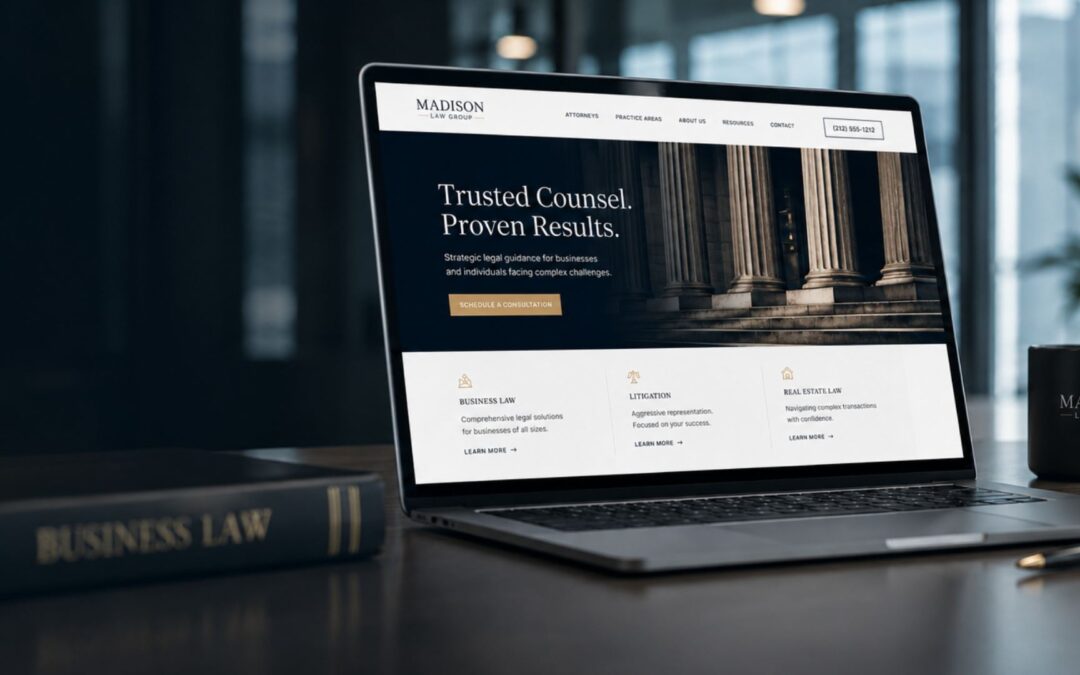
The homepage of a high-performing law firm website is not a welcome mat. It is a positioning statement. Within the first few seconds of landing on the page, a potential client should be able to answer three questions without scrolling: Who does this firm help? What do they specialize in? Why should I trust them?
Most law firm homepages fail to answer any of these clearly. They open with a generic headline like “Experienced Legal Representation” or “Fighting For You.” These phrases communicate nothing. They could apply to any firm in any city in any practice area.
High-performing firms are specific. Their homepage messaging names the type of client they serve, the problem they solve, and the geography they work in. That level of specificity is not just better for user experience. It is essential for search visibility and AI discoverability, which we will address further on.
“Within the first five seconds of landing on your homepage, a potential client should know exactly who you help, what you do, and why you are the right choice. If they have to scroll to find that out, you have already lost some of them.”
Beyond the headline, trust-first homepages stack credibility signals in a deliberate order. This includes featured media mentions, recognizable award logos, bar association memberships, years of experience, and notable case outcomes, all positioned above the fold or within the first scroll. The goal is to answer “can I trust this firm?” before the visitor has even had to consciously ask it.
Practice Area Hierarchy and Why It Matters
One of the most common structural mistakes on law firm websites is collapsing all services into a single “Practice Areas” page with a brief paragraph for each. This approach feels organized, but it is actually one of the clearest signals to search engines and AI platforms that your firm lacks depth in any single area.
High-performing law firm websites build out individual, substantive pages for every practice area they want to rank for. Not a paragraph. A full page. That page should include an explanation of the legal issue the client is facing, how the firm approaches it, what outcomes are possible, who the firm has helped, and answers to the questions clients most commonly ask before picking up the phone.
This architecture matters for a few reasons. First, it signals to Google that the firm has genuine depth and authority in that area of law. Second, it creates multiple indexed pages that can each rank for different search queries. Third, and increasingly important, it gives AI platforms enough structured, specific content to confidently surface your firm when someone asks about that exact legal issue.
- Each practice area should have its own dedicated, standalone page
- Pages should address the client’s situation in plain language, not legal jargon
- Include FAQs on each page that reflect how clients actually phrase their questions
- Internal links should connect practice area pages to relevant blog content and attorney bios
- Location-specific language (city, state or province) should appear naturally throughout each page
SEO and Intake Systems Must Work Together
Here is a problem that is more common than most law firms realize: a website that ranks well but attracts the wrong cases.
This happens when SEO strategy is disconnected from intake strategy. A firm optimizes for broad, high-volume keywords because they generate traffic. The traffic arrives. But the inquiries are off-target, the consultations are wasted, and the conversion rate stays low. The firm concludes that SEO does not work. The real problem is that the SEO was never aligned with the actual cases the firm wanted to take.
High-performing law firm websites are built with both systems in mind from the start. The keywords and content reflect the specific cases the firm wants, which means the visitors who land on the site are already closer to the right fit. The intake system, whether that is an online form, a chatbot, a consultation booking tool, or a direct phone number, is designed to convert those specific visitors efficiently.
What aligned SEO and intake looks like in practice:
A criminal defence firm in Toronto that wants to attract impaired driving cases builds a dedicated page optimized for search terms like “impaired driving lawyer Toronto” and “DUI charge defence Ontario.” The page speaks directly to that client’s situation, answers their most urgent questions, and leads them to a clear intake path. The traffic that arrives is pre-qualified. The intake form captures the information needed to assess fit quickly. The result is fewer wasted consultations and a higher retained client rate from the same volume of traffic.
Intake design is often treated as an afterthought in law firm website builds. High-performing firms treat it as a core part of the architecture. That means clear, frictionless contact options on every page, fast response time commitments that build trust, and forms that collect only what is actually needed to move the conversation forward.
Conversion Architecture Specific to Legal Services
Legal services require a different conversion approach than most industries. A person seeking legal help is often anxious, overwhelmed, and skeptical. They are not browsing casually. They are looking for reassurance that they are in capable hands before they will commit to even a free consultation.
High-performing law firm websites are built to address that emotional reality. Conversion architecture in legal services is built around three pillars: urgency, clarity, and authority stacking.
Urgency is not manufactured through pushy sales tactics. It is communicated honestly by acknowledging the time-sensitive nature of legal situations. A page on criminal charges should acknowledge that early action matters. A family law page should acknowledge the emotional weight of the situation and the value of getting guidance early. This is not pressure. It is meeting the client where they are.
Clarity means that at no point should a visitor be uncertain about what to do next. Every page should have one clear call to action. Not three options competing for attention. One. Whether that is booking a consultation, calling the office, or submitting an inquiry form, the path forward should be unmistakable.
Authority stacking means layering credibility signals throughout the site in a way that compounds. Each time a visitor encounters another trust indicator, another client review, another media mention, another recognizable award, the case for choosing this firm gets stronger. By the time they reach the contact form, the decision is already mostly made.
Authority Positioning in Competitive Legal Markets
In markets like Toronto, Vancouver, New York, Los Angeles, or Chicago, the competition for legal search traffic is intense. Dozens of firms are competing for the same keywords, the same clients, and the same attention. In these environments, generic positioning is not just unhelpful. It is a guaranteed path to invisibility.
The law firms that break through in competitive markets do it through niche clarity and content depth. They choose to be the firm for a specific type of client, in a specific situation, rather than trying to appeal to everyone. A family law firm that positions itself specifically around high-asset divorce in a particular metro area will outperform a generalist family law firm in that niche every time, even if the generalist firm has more lawyers and a bigger budget.
Content depth reinforces this positioning. When a firm publishes substantive, well-researched content on a specific area of law, it signals expertise to search engines and credibility to prospective clients. Blog posts, case breakdowns, legal explainers, and FAQ resources should not be written for search volume alone. They should be written to genuinely answer the questions that the firm’s ideal clients are actually asking. That distinction makes the content both more useful and more likely to surface in AI-generated search results.
Common Mistakes That Hold Law Firm Websites Back
Understanding what high-performing websites do differently is easier when you can see it against what most firms are still doing. These are the patterns we encounter most frequently, and the ones that are costing firms the most in lost visibility and unconverted traffic.
- Generic messaging: Headlines that could apply to any firm in any city, with no clear differentiation or positioning
- Unclear differentiation: No answer to “why this firm over another,” leaving visitors to make an arbitrary choice
- Weak internal linking: Practice area pages that do not connect to supporting blog content, attorney bios, or related services, losing SEO equity and reducing time on site
- Poor intake systems: Contact forms buried in the footer, no clear next steps, or intake processes that create unnecessary friction at the moment a visitor is ready to act
- Outdated bios: Attorney profile pages that list titles and bar memberships but fail to communicate personality, approach, and the specific cases they are best suited to handle
- No FAQ content: Missing the single easiest opportunity to rank for the long-tail, question-based searches that represent high-intent traffic
The Financial Case for Rebuilding Strategically
Law firm partners are understandably cautious about website investment. A redesign is expensive, disruptive, and the ROI is not always immediately visible. So the default becomes patching: updating a page here, adding a blog post there, refreshing the homepage photo. The site never gets fundamentally better. It just gets incrementally less outdated.
The financial case for a strategic rebuild is straightforward when you connect the numbers. A single retained client in most areas of law represents significant revenue, often ranging from several thousand dollars to tens of thousands depending on the practice area. If a strategically rebuilt website generates even two or three additional retained clients per month that the old site was not converting, the cost of the rebuild is recovered quickly. And unlike a paid advertising campaign, a well-built website continues generating value month after month without additional spend.
The firms we have worked with that made the decision to rebuild with strategy at the center consistently report a meaningful improvement in consultation quality, not just quantity. When your website attracts the right visitors and converts them with the right messaging, the calls that come in are better fits. That saves time, improves close rates, and improves the overall quality of the client roster.
How AI Search Is Changing the Game for Law Firms
This is the piece of the conversation that many law firms are not yet thinking about, but the ones that are thinking about it are gaining a significant early advantage.
AI search tools including ChatGPT, Google’s AI Overviews, Perplexity, and others are increasingly being used by people to find and evaluate professional services. When someone types “who is a good immigration lawyer in Calgary” or “best criminal defence lawyer in Miami” into an AI search tool, that tool does not simply return a ranked list of links. It generates a recommendation based on structured, credible digital signals it has pulled from across the web.
The signals AI favors for law firms are very similar to the signals that make a website high-performing for humans:
- Attorney bios with specific credentials, education, call to the bar dates, and named specializations
- Practice area pages that clearly define what the firm handles and for whom
- FAQ content written in natural, conversational language that mirrors how clients phrase their questions
- Consistent information across the firm’s website, Google Business Profile, legal directories, and social media profiles
- Third-party mentions including press features, award listings, bar association publications, and legal ranking sites
- Depth of content on the firm’s core specialization, rather than breadth across too many areas
A law firm website that is built around authority, specificity, and structure is not just optimized for Google. It is optimized for the direction that search is heading. The firms investing in this infrastructure now are building an advantage that will compound over time as AI search continues to grow as a client acquisition channel.
Answer Engine Optimization (AEO) for law firms is still an emerging discipline, but the principles are already clear: be specific, be consistent, be credible, and be structured. A well-built law firm website that follows these principles does not require a separate AI strategy. The AI strategy is baked into the foundation.
References
- Google Search Central. (2026). How Google Search works: Understanding how content is ranked. google.com/search/docs
- (2025). Local Consumer Review Survey: How people use search to find professionals. brightlocal.com
- (2025). Legal Trends Report: How clients find and choose lawyers in North America. clio.com
- Ahrefs Blog. (2025). How to build topical authority: The complete guide to content depth and SEO. com/blog
- Search Engine Journal. (2026). Answer Engine Optimization: How to optimize content for AI search tools. com
- (2025). E-E-A-T and what it means for professional services websites. moz.com
- Nielsen Norman Group. (2024). How users read on the web: Homepage UX for professional services. com
- SocialEyes Communications. (2026). Why visibility in 2026 requires more than SEO. com
- SocialEyes Communications. (2026). How AI search is changing how customers find businesses. com
- SocialEyes Communications. (2025). Google Didn’t Bring the Leads, ChatGPT Did. Is Your SEO Ready for the Future? com
The Bottom Line
High-performing law firm websites are not built around aesthetics. They are built around architecture: trust signals, practice area depth, aligned SEO and intake systems, conversion-focused design, and the kind of structured authority content that both potential clients and AI platforms are increasingly relying on to make decisions.
The firms that are growing in competitive legal markets across the US and Canada are not outspending their competitors. They are out-building them. They have invested in digital infrastructure that works around the clock, attracts the right clients, and converts them more efficiently than a generic website ever could.
Patching an outdated site will not get you there. A strategic rebuild, built around the principles outlined in this article, will. And given what a single retained client is worth to most law firms, the investment case for doing it right is not difficult to make.
Ready to Build a Law Firm Website That Actually Performs?
At SocialEyes Communications, we specialize in building authority-driven digital marketing strategies and websites for law firms across Canada and the United States. From trust-first homepage design to SEO and AEO-aligned content architecture and intake optimization, we build the systems that turn your website into your best business development asset.